
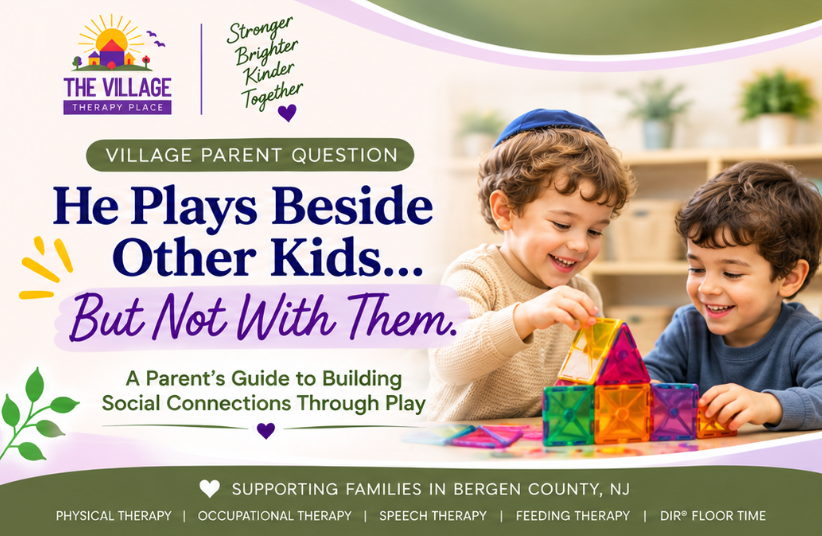
He Plays Beside Other Kids… But Not With Them.
A Parent's Guide to Building Social Connections Through Play
"He loves being around other kids, but he doesn't really play with them."
"At birthday parties, he just does his own thing."
"His teacher says he prefers to play alone."
Sound familiar?
For many parents, watching their child navigate friendships and social situations brings up lots of questions.
We want our children to enjoy being with others, make friends, and feel included.
But sometimes, even when children are surrounded by other kids, meaningful interaction doesn't come easily.
If you've ever wondered why your child plays alone instead of with other kids, you're certainly not alone. Understanding how social play develops can help you support meaningful connections.
Playing Beside Someone Isn't the Same as Playing Together
Young children often engage in what's called parallel play.
Two children may sit next to each other, each building their own tower, without really interacting.
For toddlers, this is a typical part of development.
As children grow, however, we generally begin to see more shared play.
Taking turns.
Exchanging ideas.
Pretending together.
Laughing at something silly.
Working together to build something.
For some children, these interactions develop naturally. For others, social play takes more time and support.
And that's okay.
Connection Comes Before Cooperation
When we see a child playing alone, our instinct may be to encourage them to join the group.
"Go play with your friends!"
"Ask him if you can play!"
"Why don't you share your toys?"
But here's something worth considering.
Before children can comfortably play together, they need to experience the joy of connecting with another person.
This is one of the beautiful principles behind DIR® Floortime.
Rather than immediately expecting a child to participate in group play, we begin by building meaningful, enjoyable interactions around the child's interests.
We follow their lead.
We become curious about what excites them.
We join their play.
And gradually, we look for opportunities to turn those individual moments into shared experiences.
What Can Parents Try at Home?
You don't need elaborate toys or structured activities.
Sometimes the simplest games create the best opportunities for connection.
Try building something together. If your child loves blocks, sit nearby and begin building your own tower. See whether your child notices or becomes interested in what you're doing.
Create a little playful anticipation. Roll a ball back and forth, play peekaboo, or pause during a favorite silly routine to invite another interaction.
Follow their interests. If your child loves cars, join the car play. If they love jumping, jump together!
Keep the pressure low. Shared enjoyment is more important than getting your child to play a particular way.
And remember, connection doesn't always look like a conversation.
It may begin with a smile, a gesture, a shared laugh, or a child inviting you into their favorite activity.
Take-Home Message
If your child enjoys being near other children but struggles to play with them, don't focus only on getting them into the group.
Start by helping them discover how wonderful shared interactions can feel.
Friendships grow from connection. And connection grows through relationships.
At The Village Therapy Place in Wyckoff, NJ, our team uses relationship-based approaches, including DIR® Floortime, to support children's social-emotional development, communication, and meaningful connections with others.
Social Play and DIR Floortime in Bergen County NJ